Fieldwork Educator Resources
Adapted from Direct Skills Teaching- Coaching the Client, Cohen M., Danley, K., Nemec, P.
Critiquing progress is leading a learner (student, patient, supervisee, or colleague) through an assessment of his/her performance and future learning needs. It provides an excellent format to involve the learner in self-reflection and learning. It empowers the learner by encouraging him/her to actively participate in the learning process.
It can be done whenever a new skill or activity is taught or attempted. It is a useful learning process in any relationships where learning takes place: supervisor/supervisee, teacher/student, therapist/patient, mentor/mentee, etc.
Critiquing is best done interactively with both the coach and learner assessing performance and suggesting future learning needs. This process involves asking questions, listening, and giving constructive feedback. It focuses on three points:
- Assessing strengths and weaknesses in performance
- Determining reasons for them
- Planning future learning activities
The procedure begins with a brief, general, overall assessment of the learner’s performance, which encourages him/her to openly share his/her feelings about how s/he did. The learner’s overall self-assessment alerts the coach to the learner’s “degree of self-awareness” about how well s/he performed.
The procedure invites the learner to be the first to assess. The coach then presents his/her perspective to add to the learner’s critique. In essence, the coach leads the learner through a self-critique and then only shares his/her perspective if or when needed.
Sometimes it is necessary for the coach to share his/her perspective before requesting a self-critique from the learner. Usually this is done when a learner is consistently inaccurate or unwilling to share his/her thoughts first.
The following page suggests a step-by-step procedure for critiquing. It emphasizes asking the learner to share first, and the coach adding additional information only as needed.
Procedure for Critiquing Progress
-
Share Immediate Overall Reactions
- Ask the LEARNER: Ask the learner to give an overall (general) self-assessment of his/her own performance, including the positive or negative emotions.
Example: Overall, how do you feel you did _______ (the activity, exercise, assignment)? - COACH: Describe your overall (general) assessment and feeling about the learner’s performance if positive or generally consistent with the learner’s assessment
- Ask the LEARNER: Ask the learner to give an overall (general) self-assessment of his/her own performance, including the positive or negative emotions.
-
ASSESS SPECIFIC STRENGTHS/DEFICITS
- Ask the LEARNER: Ask the learner to describe the strengths and deficiencies in his/her performance.
Example: What specifically do you think you did well? What do you think you didn’t do as well? - COACH: Describe the specific strengths and deficiencies in the learner’s performance. Begin with those that are similar to the learner’s perspectives and, if needed, conclude with those that are different in perspective
- Ask the LEARNER: Ask the learner to describe the strengths and deficiencies in his/her performance.
-
ANALYZE SPECIFIC REASONS
- Ask the LEARNER: Encourage the learner to suggest specific reasons for his/her strengths and deficiencies in performance.
Example: What specifically helped you do ________ well? Why was _______ difficult for you? - COACH: Suggest additional reasons for the learner’s strengths and deficiencies.
- Ask the LEARNER: Encourage the learner to suggest specific reasons for his/her strengths and deficiencies in performance.
-
PLAN STRATEGIES FOR IMPROVEMENT
- Ask the LEARNER: Ask the learner to suggest how to improve performance.
Example: What specifically might you do next time to improve how you ________? - COACH: Offer additional suggestions of how the learner can improve performance.
- Ask the LEARNER: Ask the learner to suggest how to improve performance.
-
SHARE ADDITIONAL THOUGHTS AND FEELINGS
- Ask the LEARNER: Invite the learner to discuss any performance issues not previously discussed.
Example: Is there anything else we should discuss to help you to _______? - Ask the LEARNER: Encourage the learner to describe his/her overall feelings about the critique.
Example: Overall, how do you feel about this learning experience? - COACH: Summarize your overall feelings about the learning experience.
- Ask the LEARNER: Invite the learner to discuss any performance issues not previously discussed.
- Assume the role of an intentional fieldwork educator
- Acknowledge that you are a vital part of the student’s education.
- Simultaneously assume your role of educator and clinician.
- While engaging a client in a cooking activity, the clinician-educator demonstrates and explains adaptive techniques to the student.
- At the conclusion of a student led treatment session, the clinician- educator provides the student with feedback.
- Invite and immerse your student into the clinic culture
- Be aware of your clinic’s/setting’s culture.
- Inform your student of the clinic’s cultural norms/practices.
- “The last Friday of the month the staff bring a covered dish to share.”
- “Susie always sits in the comfy black chair during meetings.”
- Share clinic stories
- “We refer to the staff lounge as no man’s land.”
- Establish rapport/relationship with the student
- Introduce your student as a team member.
- Avoid the “THE STUDENT” mentality.
- Invite your student to eat lunch with the team.
- Include your student in professional and casual conversation.
- Introduce your student as a team member.
- Determine communication and learning styles
- Identify your and your student’s communication style.
- Modify your communication style to accommodate student needs.
- The aggressive communicator may need to temper their style, while the passive communicator may need to push themselves to communicate more effectively.
- Modify your communication style to accommodate student needs.
- Identify your teaching style and the student’s learning style.
- Utilize learning style assessments.
- Educate according to the student’s learning style.
- Identify your and your student’s communication style.
- View teaching/learning through the lens of OT
- Analyze tasks/activities, environments, and learning demands.
- What are the demands placed on the student by the task at hand?
- Is the busy gym interfering with the student’s ability to re-demo a skill?
- Is sufficient time provided for the student to process, integrate, and apply newly learned skills/information?
- Grading and/or Modifying
- Ask yourself if the task demands can be modified to meet the “just right challenge” for the student considering the time frame of the rotation?
- Allow the student to document at the end of the day or session rather than during the session.
- Allow the student to practice a skill in a client’s room versus a busy gym.
- Permit the student to review the assessment tool prior to its administration.
- Provide opportunities for the student to pre-plan treatment sessions.
- Increase or decrease the caseload demands based on client complexity, number of clients, and pace of the setting.
- Ask yourself if the task demands can be modified to meet the “just right challenge” for the student considering the time frame of the rotation?
- Analyze tasks/activities, environments, and learning demands.
- Facilitate varied, meaningful learning experiences
- Create intentional learning opportunities.
- Match the student with a client, population, or a situation, which will develop a targeted skill.
- Seek out opportunities for the student to experience a variety of interventions/techniques.
- Arrange opportunities to observe procedures, other disciplines, techniques.
- Provide opportunities to educate clients, families, caregivers, healthcare and other professionals, populations, communities.
- Plan meaningful assignments that will broaden the student’s knowledge base, encourage inquiry, and spark interest.
- Capitalize on impromptu learning opportunities
- Recognize teachable moments.
- Mr. M. became dizzy with sit/stand. Inquire of the student as to what may be the cause and what response is indicated.
- Seize the moment
- Sally therapist has a new order, hot off the press, to evaluate a trauma patient; you request that the student be present for the evaluation.
- Deliberately turn an unexpected situation into a learning opportunity
- Your 10:00 client cancels. During this gap in the schedule, you have the student explore resources to increase their understanding of an atypical diagnosis.
- Recognize teachable moments.
- Create intentional learning opportunities.
Created by: Joy Crawford, MSRS, OTR/L & Nadine Hanner, MSOT, OTR/L
March 13, 2018
Adapted from Situational Leadership Model by Paul Hersey, https://situational.com/the-cls-difference/situational-leadership-what-we-do/
It is expected that the nature of supervision will change - evolving over the course of the fieldwork. Initial supervision is typically more directive (frequent input and highly structured).
As the fieldwork student develops skills and a better understanding of what is required, you may become less directive and adopt a coaching style (providing regular feedback, but back off a bit). Especially during the initial phases of supervision, the student should be expected to actively participate by sharing ideas, opinions, and feelings, and by following through with designated plans.
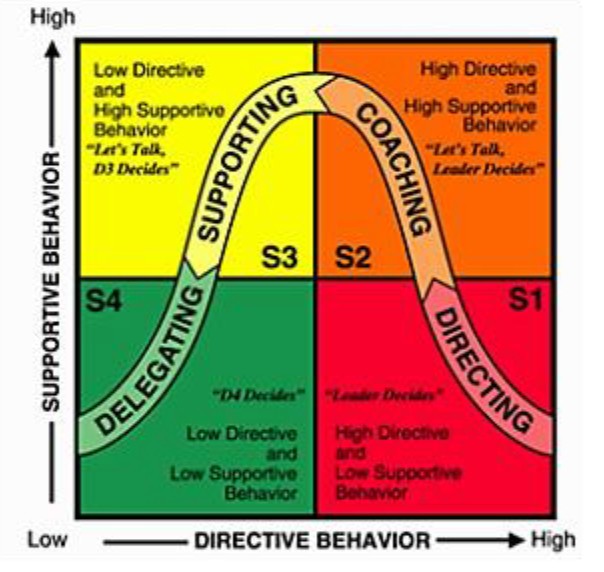
DIRECTING > COACHING > SUPPORTING > DELEGATING
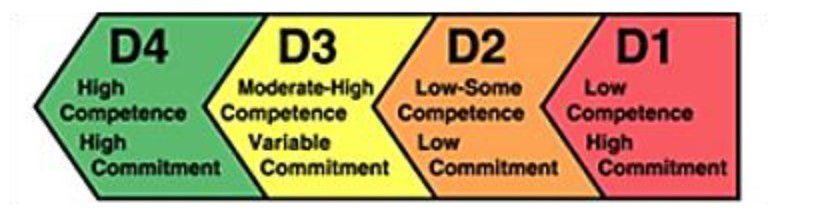
Generally, at the midpoint of the fieldwork, as the student takes on more responsibility and demonstrates increased competence and confidence, you may assume more of a supportive role (being readily available to answer questions and provide feedback as needed or requested). At this time, the student should be actively engaging in problem identification, problem solving, and goal setting.
Decision-making becomes a shared responsibility, with you providing assurance and resources to facilitate learning. In the final stages of fieldwork, the student should assume greater responsibility for decision-making and independently carry out work activities that are delegated and monitored by you.